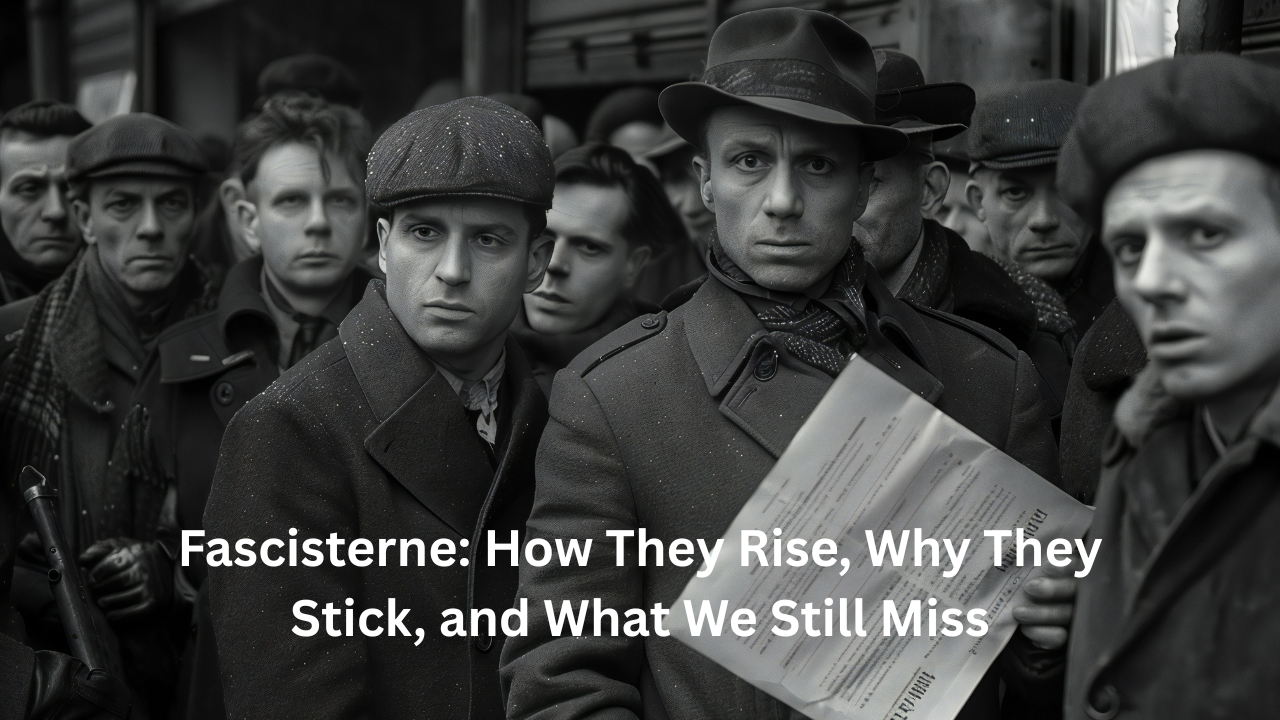
There’s a reason the word fascisterne still carries weight long after the regimes themselves fell. It’s not just history. It’s a warning that never quite fades.
Most people picture black uniforms, rigid salutes, and loud speeches echoing through crowded squares. That’s part of it. But the real story is quieter, more gradual, and frankly more uncomfortable. Fascism doesn’t usually burst through the door. It slips in, makes itself useful, and only later shows its full face.
Let’s talk about how that actually works.
The appeal most people don’t want to admit
Here’s the thing. Fascism didn’t grow because people were evil. It grew because it solved problems—at least on the surface.
After World War I, countries like Italy and Germany were in chaos. Jobs were scarce. Inflation was out of control. Governments looked weak. People felt humiliated and ignored.
That’s where figures like Benito Mussolini and Adolf Hitler stepped in. They didn’t start by talking about oppression or control. They talked about order. Pride. Stability.
Imagine you’re a factory worker in 1920s Europe. Your savings are worthless. Your job is gone. Politicians argue while your life gets worse. Then someone comes along and says:
“I can fix this. I’ll restore your country. You’ll matter again.”
That’s powerful. It feels like relief.
Not just politics, but identity
Fascism isn’t just about government structure. It’s about identity.
It tells people who they are—and just as importantly, who they’re not.
There’s always a strong “us versus them” narrative. The “us” is pure, hardworking, loyal. The “them” is blamed for decline. That group changes depending on the country and time, but the pattern stays the same.
You can see how this plays out in everyday life. Think about how easy it is to bond over a shared enemy, even in small things. A workplace blaming another department. A community blaming outsiders for local problems.
Now scale that up. Add economic stress. Add a charismatic leader. It becomes something much bigger.
The slow shift toward control
People often imagine fascism arriving overnight. It doesn’t.
It’s more like a series of small adjustments. Each one seems reasonable on its own.
First, stricter laws for “security.”
Then, limits on certain voices “for stability.”
Then, loyalty becomes more important than competence.
Before long, disagreement starts to feel risky.
A journalist hesitates before publishing. A teacher avoids certain topics. A neighbor stops speaking openly.
No one moment feels like the breaking point. But the environment changes.
And once that shift happens, reversing it is much harder than people expect.
Why strong leaders become irresistible
Let’s be honest. In uncertain times, people crave certainty.
A strong leader offers simple answers. No long debates. No complicated compromises. Just clear direction.
That’s part of the appeal behind figures like Francisco Franco or even modern leaders who borrow similar tactics without fully embracing fascism.
They project confidence. Decisiveness. Control.
But there’s a tradeoff. That clarity often comes at the cost of truth.
Complex problems get reduced to slogans. Opponents get labeled as enemies. Institutions get weakened because they slow things down.
At first, it feels efficient. Later, it becomes dangerous.
The role of fear and repetition
Fear is a powerful tool. Fascist movements use it carefully.
Not always through obvious threats, but through constant messaging.
Crime is exaggerated. Enemies are made to seem everywhere. The future is painted as fragile.
If people feel unsafe long enough, they’ll accept almost anything that promises protection.
Repetition plays a big role too. Say something often enough, and it starts to feel true—even if it isn’t.
You’ve probably seen a smaller version of this online. A rumor gets repeated, shared, reposted. Suddenly it feels like common knowledge.
Now imagine that happening at a national level, backed by media and authority.
Everyday life under fascisterne
Life under fascism isn’t always dramatic. In fact, much of it looks normal on the surface.
People still go to work. Kids still go to school. Shops still open.
But there’s a tension underneath.
Conversations become cautious. Humor changes. Trust shrinks.
A simple example: imagine you’re at dinner with friends. Someone makes a political comment. Normally, it would spark a debate. Now, everyone pauses. Who’s listening? Who might report it?
That quiet hesitation tells you everything.
Why resistance is harder than it sounds
It’s easy to say, “People should have resisted.”
Reality is messier.
By the time fascism is fully visible, it’s already embedded. Institutions are weakened. Opposition is fragmented. Fear is normalized.
And most people are just trying to live their lives.
You have a job. A family. Responsibilities. Taking a stand suddenly feels risky, even reckless.
Some people do resist, of course. On its own, it’s usually not sufficient.
The modern echo
Here’s where it gets uncomfortable. The patterns behind fascisterne haven’t disappeared.
They show up in smaller ways. Different forms. Different countries.
Not always full-blown fascism, but similar instincts:
Blaming outsiders for internal problems
Attacking independent media
Glorifying a single strong leader
Reducing complex issues into simple slogans
You can see fragments of it in political rhetoric, social media, even everyday conversations.
That doesn’t mean history is repeating exactly. But the building blocks are still there.
Why it still matters
It’s tempting to treat fascism as a closed chapter. Something tied to a specific time and place.
But that misses the point.
Fascism isn’t just a system. It’s a pattern of thinking. A way of responding to fear, uncertainty, and identity.
And those conditions never fully go away.
The real lesson isn’t just “don’t repeat history.” It’s understanding how easily ordinary people can be drawn into something harmful when it feels like a solution.
A quieter kind of vigilance
So what do you actually do with all this?
It’s not about constant alarm or dramatic action. It’s more subtle.
Pay attention to how problems are framed. Notice when groups are simplified into villains. Question easy answers to complicated issues.
And maybe most importantly, stay comfortable with disagreement. Healthy societies argue. They debate. They tolerate friction.
The moment everything starts sounding too unified, too certain, too controlled—that’s worth paying attention to.
Final thoughts
Fascisterne didn’t rise because people wanted oppression. They rose because people wanted stability, pride, and direction.
That’s what makes the story so relevant.
The same needs exist today. Always will.
The difference lies in how those needs are met—and whether people are willing to look beyond simple answers.
History isn’t just something that happened. It’s something that keeps trying to happen again, in quieter ways.
And spotting those patterns early is far more powerful than reacting once they’ve taken hold.
